- Superb monograph in a high-quality Charles Meunier binding
"The bookbinding brewer"
Apprenticed from the age of 11, trained under Marius Michel, Charles Meunier holds a unique place in French bookbinding,
as a standard-bearer for "emblematic" binding, due to his independence (he refused to compete in the 1900 Universal Exhibition),
his originality, and his experimentation. He would go on to become a publisher and then a lecturer to explain his own ideas regarding
bibliophily (including in New York in 1906).
- History of Popular Imagery by Jules Félix Husson, known as Champfleury
Contains: "The Wandering Jew, History of Good Man Misery, Credit is Dead, The Farce of the Hunchbacks, Abbé Chanu,
Lustucru, The Recollet of Châteaudun, The Dance of Death in 1848, The Imagery of the Future"
In his preface to Dr. Reinhold Koehler (celebrating the international friendship of researchers), Champfleury explains
that this study is part of his long-standing ("archaeological") research spanning more than 18 years.
- Champfleury, a forgotten polygraph of the 19th century
Champfleury, journalist, novelist, and art critic, friend of Victor Hugo and Flaubert, admirer of Balzac,
but also an expert in cats and earthenware (he would become curator of the Sèvres National Museum of Ceramics), and
finally, a theorist of realism.
From 1860, he devoted himself to scholarly publications on minor arts, in an innovative way for the time, and became
thereby a defender of popular art.
According to Annie Duprat (persee), Champfleury contributed to giving popular imagery its stamp of legitimacy.
Champfleury became aware of his own pedagogical mission: after studying the traces of the imagery of the past,
the writer insists on the need to approach a new kind of imagery that would oscillate between tradition and modernity.
This position is clearly stated in the final chapter of The History of Popular Imagery,
where the author questions the future of this form of expression. According to him, popular art must adapt to the transformations
of the techniques and venues for disseminating images: hence the proposal to display gargantuan frescoes
in large public spaces for crowds of passersby.
Of his passion for popular arts, only the traces of a vast and protean body of written work remain today.
https://www.persee.fr/doc/acths_1764-7355_2010_act_132_4_1757
https://www.uneimagenemeurtjamais.com/post/champfleury-et-les-images-populaires
https://www.berose.fr/article569.html
https://shs.hal.science/halshs-03409256/document
https://bibliophilie.com/portrait-de-relieur-charles-meunier-1866-1948-une-reliure-par-jour/
E. Dentu Editions
1886
New edition, revised and expanded
Format 13*19.5 cm, long preface XLVIII p + 286 p
One of the rare copies on laid Holland paper
(the Dentu bookstore usually published a small number of copies on luxury paper,
for example, 50 copies for the secret museum of caricature by Champfleury in 1886, see catalog at the end)
Embellished with 42 beautiful wood engravings
including a color frontispiece
Superb half-morocco binding with corners in Art Nouveau style
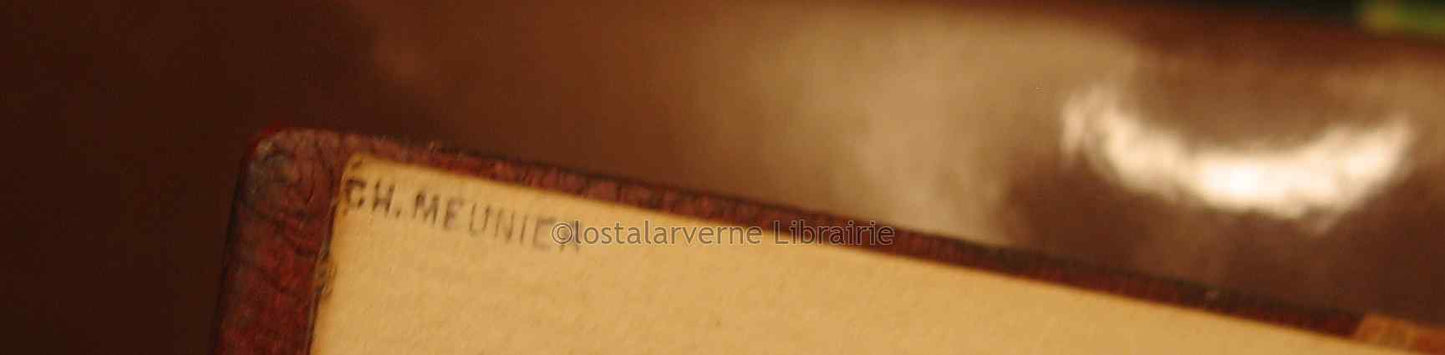
Signed Charles Meunier
one of the master bookbinders of the 19th century
Superb floral ornamental and inlaid spine
Top edge gilt
Covers preserved
Condition
Very fine work with slight wear from use
- slight rubbing to the corners
- some foxing on a few pages of the preface
- some margins slightly darkened
- some soiling on the wide margins